Four of us stood beside a public entrance with our arms in the air, holding blank metal panels flat against a curved column. No drawings, no presentation. Just squares of coated aluminium, a few lab labels and a lot of squinting.
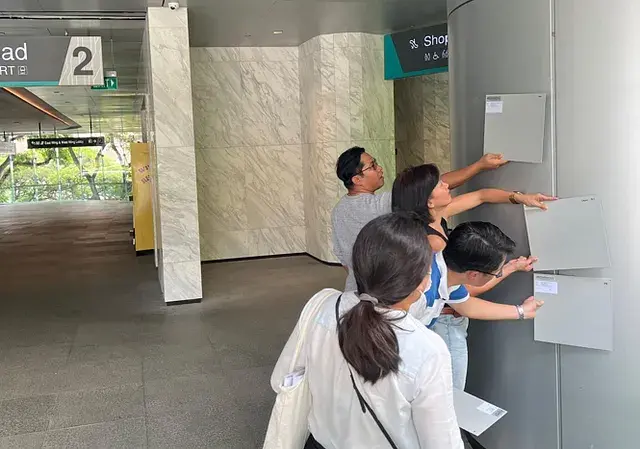
Anyone walking past would have been entitled to wonder what was wrong with us. It looks faintly unhinged, and it is also the only honest way to choose a façade colour.
The panels were near-identical shades of off-white and silver-grey, one marked Original, the rest labelled with coating type, gloss and batch reference. Indoors, under downlights, we could not tell them apart. Out here—sky behind them, daylight coming off the atrium floor and back off the glass—they stopped matching. Not dramatically. Just enough.
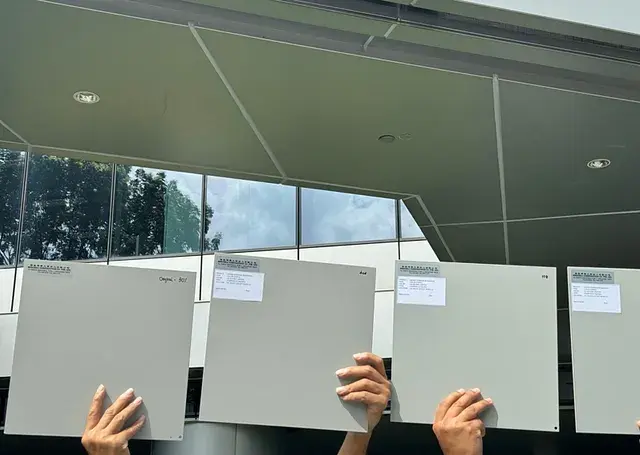
The discussion appeared to be about colour. It was really about how the building would age.
A finish is never approved in the room where it is chosen. It is approved by the light it will live in—and it has to survive twice. First fabrication, transport, storage and installation. Then decades of sun, rain, cleaning chemicals and, on some sites, salt off the sea. The one that wins the second test is often the least forgiving in the first.
Silver Is Not Just Silver
Aluminium finishes get discussed in colour. Silver. Champagne. Bronze. Grey.
Colour is only the outcome. The real question is what was done to the metal. Powder coating applies a dry powder electrostatically and cures it into a protective layer. PVDF is a fluorocarbon system, chosen where weathering and colour retention matter most. Anodising is different in kind—it does not sit over the metal, it changes the metal's own surface electrochemically, growing a controlled oxide layer.
Three systems. Three near-identical shades. Three different lives once the façade leaves the sample room.
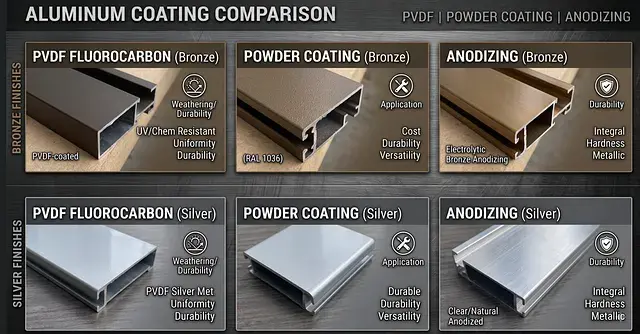
PVDF: Strong Against Weather, Less Forgiving on Site
PVDF earns its place where exposure is the real concern. It holds colour under strong sunlight and resists the slow fade of weathering, which is why it turns up so often on high-rise curtain wall.
On a coastal site the sea is not only the view. Salt travels through the air and settles where rain never reaches to wash it off—ledges, joints, shadowed returns. A sheltered site and a tower facing the water can use identical members and still not live in the same conditions. Even then, the coating is only part of the answer: a strong finish cannot rescue a weak detail.
The harder problem arrives earlier, during construction. A frame can leave the factory perfect and still be packed, transported, stored, lifted, installed, then left standing while other trades work around it. One scratch can become a surprisingly long discussion.
PVDF can be touched up, but the repair rarely disappears. The colour may be close while the sheen catches light differently. A touch-up invisible from the ground is perfectly visible from the balcony next door. Replacing the member is cleaner, and raises its own question: will a later batch match what is already up? Which is why PVDF asks for discipline before the damage rather than after.
PVDF survives the weather. It rarely forgives the journey there.
Powder Coating: The Practical All-Rounder
For residential windows in an ordinary urban environment, powder coating is usually the most balanced choice. It gives architects range—smooth, matt, satin, fine texture—and a lightly textured finish forgives small handling marks.
It is also easier to touch up locally than a highly metallic PVDF, which matters once you consider what a large residential project is: thousands of components, each passing through fabrication, transport, storage and several pairs of hands. Twenty years of weather—twenty months of construction first.
It gets dismissed as the cheap option, and that is too simple. Powder coating comes in genuinely different performance grades, and pretreatment, coating quality and applicator all matter. A properly specified architectural system and a basic low-cost coating are not the same product at different prices. So the question is never powder coating or not, but what grade of it this building needs.
Anodising: When Aluminium Should Still Look Like Aluminium
PVDF and powder coating place a finish over the aluminium. Anodising changes the aluminium itself, so the frame still reads as metal rather than metal covered in paint.
That gives it a depth coated finishes struggle to reproduce. Silver, champagne and bronze respond to changing daylight—brighter in the morning, cooler under cloud, deeper in late afternoon. Where the intent is a mullion that stays unmistakably metallic, anodising is hard to fake.
Its strength is its complication. Because the metal stays visually present, so do small differences in it: two adjacent members can read slightly different. Some call that natural variation. Others call it a defect. That expectation has to be settled early, not discovered on the façade.
One constraint never appears on a sample panel: anodised members must physically enter processing tanks, and tank length decides which factories can take the job at all. And repair is not repainting—once a member is badly damaged, the conversation moves to replacement.
From Panel to Mock-Up
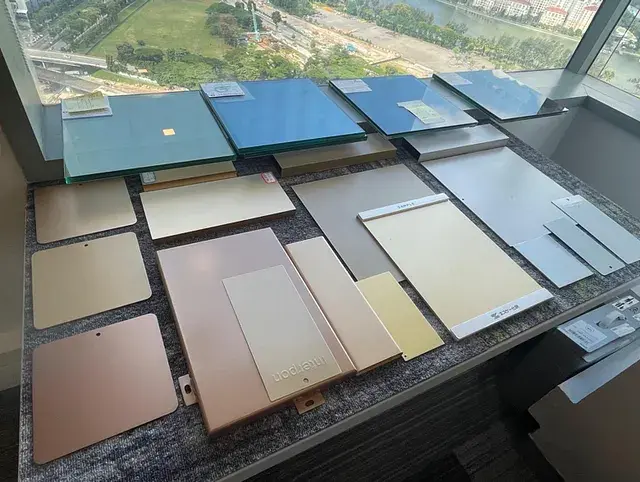
A panel held against a column settles one question: does this colour work here. It cannot settle the ones that follow.
So the samples are brought together before the building is. Glass, aluminium, gasket and sealant laid out on one table, in daylight, in the combinations actually proposed—because a finish is never seen alone. The same silver-grey reads warmer, darker or flatter beside different glass, and a carefully chosen frame still looks wrong if a heavy black gasket is what the eye lands on.
Then comes the visual mock-up. A full-scale piece of the façade, built outdoors, in the real orientation, by the people who will build the rest of it.
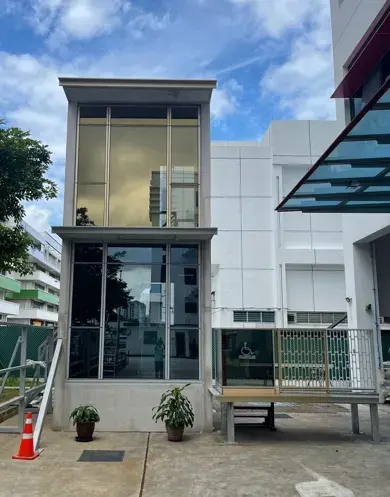
This is where a metallic finish finally tells the truth. Directionality does not show on a small chip; it shows across an uninterrupted plane, at an angle, from the distance a person will actually stand. Frame widths that looked slender in elevation gain weight. Sightlines that resolved neatly on paper collide. The sheen shifts as the sun moves, and everyone standing there sees it at the same moment.
It also tests more than appearance: whether the detail can be built at all. Sequence, tolerance, drainage, the junction with structure, the workmanship of a crew who will repeat it several hundred times. It is the first time the design is executed rather than described.
The objection is fair. Mock-ups cost money and programme, and a contractor asked to build one before the design is frozen is being asked to price uncertainty. But a change at mock-up stage is a conversation. The same change after fabrication has started is a variation, and after installation it is an argument.
Which makes the useful question not whether to build a mock-up, but what it is being built to decide—and settling that list before it goes up. Otherwise it becomes an expensive photograph.
Then Comes the Cost
Standard powder coating sits at the economical end, and pushing the durability grade up moves the price with it. PVDF and anodising usually carry a premium over that baseline, though not in a fixed order—the number moves with colour, anodic thickness, quantity, profile geometry, applicator and factory capacity. Procurement rarely cooperates with a hierarchy that tidy. And a modest per-square-metre premium becomes a real line in the tender once multiplied across kilometres of frames and fins.
First cost is also only half the sum. Powder coating costs less to buy and less to fix; PVDF costs more and repays it in weathering. A more affordable coating chosen to win a tender does not remove the cost—it defers it into maintenance and early replacement.
The developer's job was never to specify the most expensive finish. It is to specify enough performance for this building's actual exposure, appearance expectation and maintenance strategy. A harder decision than picking the prettiest sample, and a much quieter one.
The Scratch Ten Years Later
A member scratched during construction is manageable: the supplier is still engaged, the colour record exists, the line is running.
The same damage fifteen years later is a different problem. The building is occupied, the façade has weathered, the applicator may be long gone. The specification still exists on paper, but a newly produced member can be technically correct and visually wrong, because everything around it has aged and it has not. Can it be cleaned? Repaired locally? Can the finish still be reproduced, and how will a new panel sit beside fifteen-year-old neighbours?
The MCST inherits the answers to questions it was never in the room to ask. Maintainability does not begin after TOP. It begins at specification.
What Even the Mock-Up Cannot Tell Us
And still, it only answers the questions of today. Do we like how this looks, here, in this light. It cannot tell us how the finish weathers beside the sea, how consistent the next production batch will be, or whether one member can still be matched in ten years.
Those questions sit outside the aluminium rectangle in our hands—and they are what we approve when we stand in a public walkway, arms in the air, and say this one.
The colour is chosen in a morning. The building lives with the decision for decades.
Originally published on Medium on 12 August 2026.