On a Government Land Sales closing day, the lobby at the Urban Redevelopment Authority always feels the same. Same faces. Same quiet. Everyone holding their own version of conviction. You walk in, hand over the envelope, get an acknowledgement, and loiter around to wait for the 12pm closing time. That is the public moment. What follows is not.
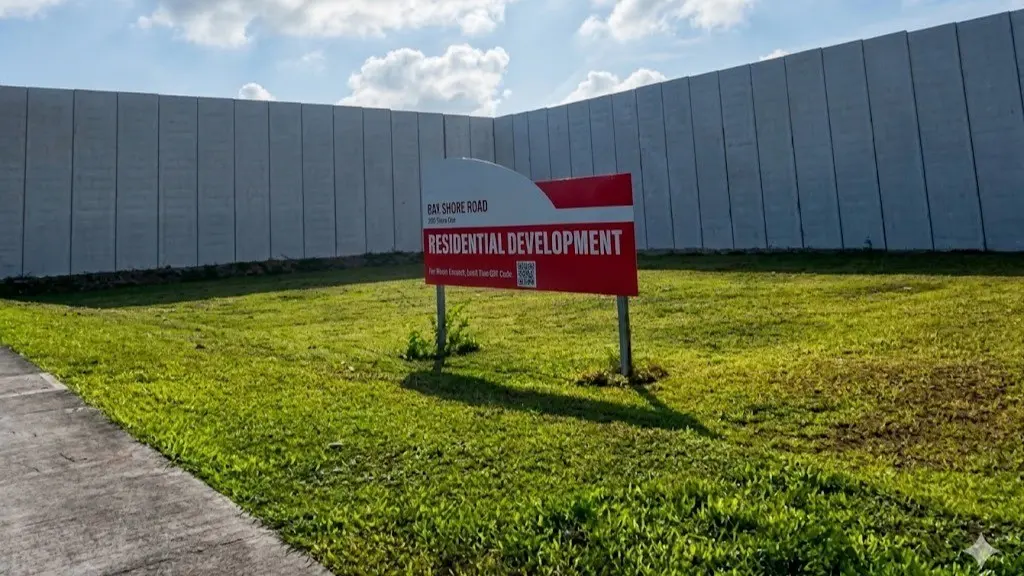
Most of the real work in a GLS tender compresses toward the end. The early weeks are exploratory—understanding the site, reading demand, shaping a position. But as the closing date approaches, conversations sharpen. Unit mix evolves. Construction costs are rebuilt—not because the numbers are unclear, but because the consequences are. Each adjustment carries a financial commitment within it, disguised as a design move.
On the morning of the March 2025 tender close, we went through the numbers one last time. Not to redesign—that window had already closed. The purpose was reaffirmation. Then we headed down.
We submitted a confident number. But certainty never extends to the outcome. There is always the possibility of a figure you did not see coming—a silent bidder, a different reading of risk. So we waited. Around 6pm, the website updated. A brief silence. Then relief, sometimes applause. Messages streamed in. Phones lit up. For a moment, the room felt light.
But anyone who has been through more than one cycle knows this is not a finish line. It is ignition.
Constraint, Not Control
From the outside, winning a GLS looks like control. From the inside, it is constraint.
The five-year timeline under Singapore's Additional Buyer's Stamp Duty (ABSD) framework is not simply a tax provision. It is a behavioural system. Developers must complete construction and sell every unit within five years of acquiring the site. Miss it, and the penalty is punitive enough to erase margins.
What is less visible is how deliberately this system has been tightened over time. When ABSD was introduced in 2011, it was measured. By 2013, it strengthened. In 2018, it moved sharply. By 2021, it tightened further. In 2023, it reached its most aggressive stance yet.
The direction has been consistent—not cyclical, but structural. Each iteration removes a little more room to wait, a little more tolerance for delay. The intent is clear: no land banking, no waiting for a better cycle. Capital must move. Supply must reach the market.
Waiting is not a strategy here.
The Illusion of Five Years
On paper, five years appears generous. In practice, part of it is already gone the moment the site is awarded.
A typical project consumes twelve to eighteen months in design development, approvals, tendering, and mobilisation before a single pile is driven. Construction stretches close to three years and more after that. What remains is not a buffer. It is a narrow, unforgiving window.
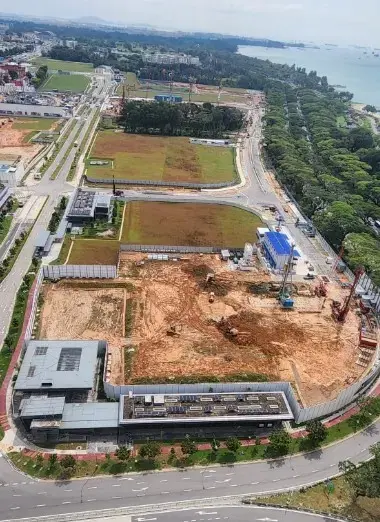
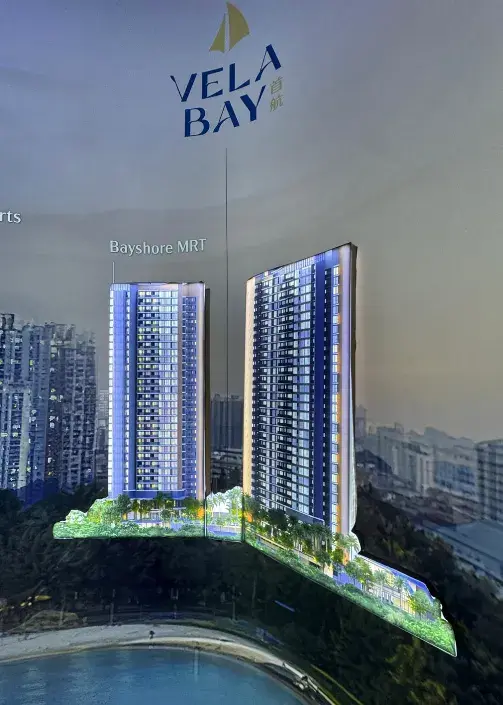
And the constraints do not stop at award. After we won the Bayshore site, CAAS revised its height guidelines—enabling taller towers than originally contemplated. A welcome outcome. But it required a rethink of structure, orientation, and façade mid-stream. Twin 31-storey towers, elevated nine metres above street level, northwest-southeast facing. More units with uninterrupted sea views. The design is better for it. The timeline absorbed the consequence.
The moment the land offer is accepted, numbers stop being theoretical. Land cost is fixed. Financing activates. Interest compounds. Meetings sharpen. Decisions compress. Tolerance for drift narrows.
What reads externally as urgency is, internally, something simpler. It is financial physics.
Every delay does not merely shift the programme. It consumes the only resource that cannot be recovered.
Sales Launch as Convergence
There is a persistent assumption that developers push for early launch for branding or momentum. That is not what drives it.
Launch is a convergence point where multiple streams must align within a narrow window—planning approvals, building plan clearance, legal documentation, and a physical showflat. None of these processes move in sequence. Authority comments arrive unevenly. Design evolves while approvals are still in flight. Technical constraints surface just as layouts are being frozen.
The challenge is not speed. It is sequencing.
Move too slowly and cost accumulates. Move too quickly and errors get embedded. Speed and certainty rarely arrive together.
The Land Before the Land
There is another constraint that rarely surfaces in conversations about timelines. It is not about design, approvals, or construction. It is about land—but not the development site itself.
To launch, a project needs a physical place to sell from. In most GLS configurations, a showflat cannot sit on the development site without compromising active work. So the developer must secure an alternative—close enough, visible enough, compliant enough.
In practice, suitable sites are scarce. Often already taken. During active market cycles, teams scan the island—not for acquisition, but for temporary use. It sits somewhere between planning and improvisation.
For Grand Dunman, that search took more than six months and involved over thirty sites before one was secured. The Singapore Land Authority manages the process, but multiple agencies move in parallel, each on its own timeline.
The system has begun to respond. It helps. But it does not remove the constraint.
In a land-scarce city, even temporary land is contested. And the clock does not slow down.
Why the Contractor Comes In Earlier
Even when a showflat site is secured, another dependency quietly shapes whether a project can move with confidence.
The contractor.
Construction does not begin when ground is broken. It begins when the method is chosen. If a project adopts PPVC or other industrialised systems, that decision cascades into layout, structure, and façade. What appears flexible becomes constrained. Without a contractor in the room, these remain assumptions. With one, they become parameters.
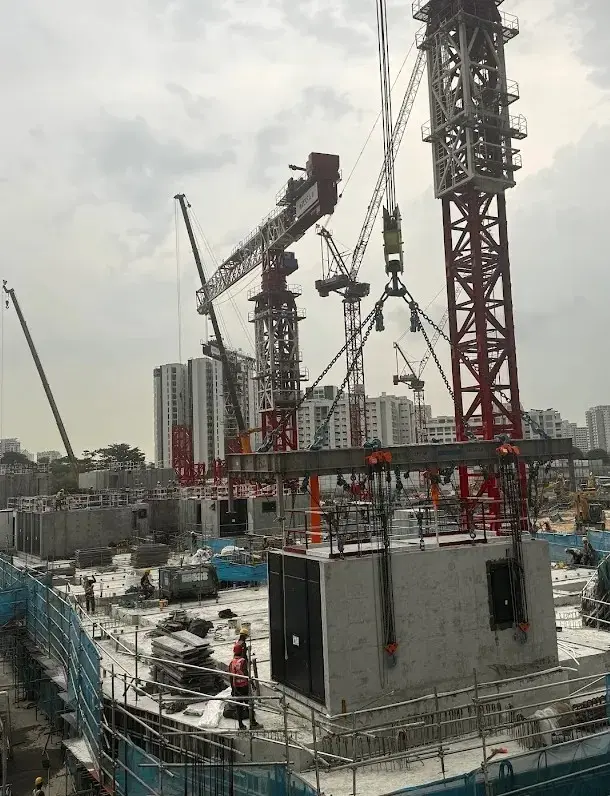
This is why early contractor involvement is no longer optional. It is an adaptation.
Risk Moves Forward
What the ABSD framework ultimately does is not remove risk. It redistributes it—forward, into earlier decisions.
Design is frozen earlier than ideal. Contractors are engaged before full certainty exists. Launch proceeds with known imperfections—not because teams are careless, but because waiting carries a greater cost.
There is also the matter of what the market does not pause for. Construction cost headwinds do not wait for project readiness. Diesel and bitumen prices have spiked since the Middle East conflict escalated in early 2026, hitting foundation, piling, and earthworks contractors hardest. Budgets may carry allowances for volatility, but no contingency fully absorbs prolonged market shifts. The pressure is real, and it arrives regardless of where the project stands.
The champagne lasts ten minutes. The alignment effort runs for five years.
What Gets Launched
The visible moment is the sales gallery—the showflat, the signage, the turnout. What actually launches is a tightly coupled system in which everything must now move in lockstep, with almost no room for drift.
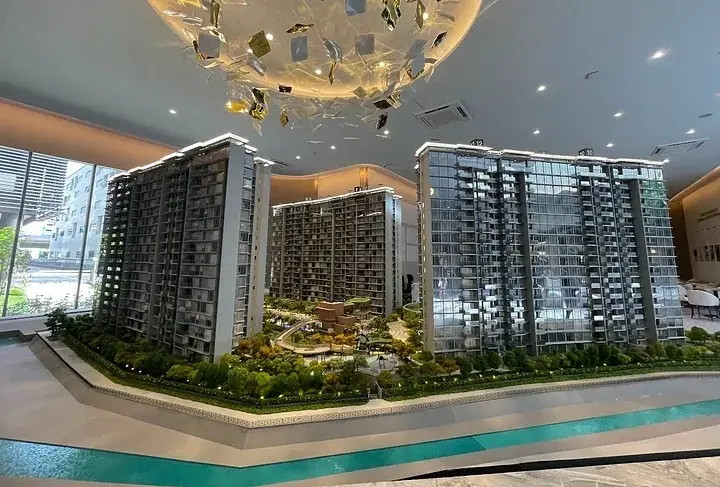
In Singapore, development is not simply the act of building. It is the act of operating within a system deliberately designed to keep land in motion. The bid is the visible moment. Everything that follows is quieter—and far more decisive.
Vela Bay
Today, Vela Bay has been launched.
The turnout is strong. The response is encouraging. From the outside, it reads as a moment of arrival—the first private residential development in a precinct that has not seen a new launch in over twenty years, anchoring the opening chapter of a 60-hectare coastline transformation.
For the team, it reads differently. More than twelve months have already passed since that tender day. The clock did not pause—for design refinement, for the CAAS revision absorbed mid-stream, for the approvals, the coordination, the decisions that had to be made before we were fully ready to make them.
It moved. Quietly. Relentlessly.
It will become a beautiful project. That part, people will see.
What they will not see is the compression behind it—the decisions made earlier than ideal, the trade-offs absorbed without announcement, the alignment held under sustained pressure across a long and largely invisible stretch of work.
That work does not appear in photographs. But it is what allows the project to stand.
The skyline shows the outcome. The system carries the weight.
Originally published on LinkedIn on 10 May 2026. The first version appeared on Medium in Skyline Thinking by HC.